Binance integration · USDT-M futures

Automate Crypto Futures Trading on Binance

Connect your Binance account with an API key that can read and trade futures but never withdraw, or practise on the Binance Futures testnet first. Then build a bot that trades USDT-M perpetuals from your signals, with take profit, stop loss and Binance’s own trailing stop. Six steps, no code.
Reading and Futures only
Demo on the testnet
Binance trailing stop
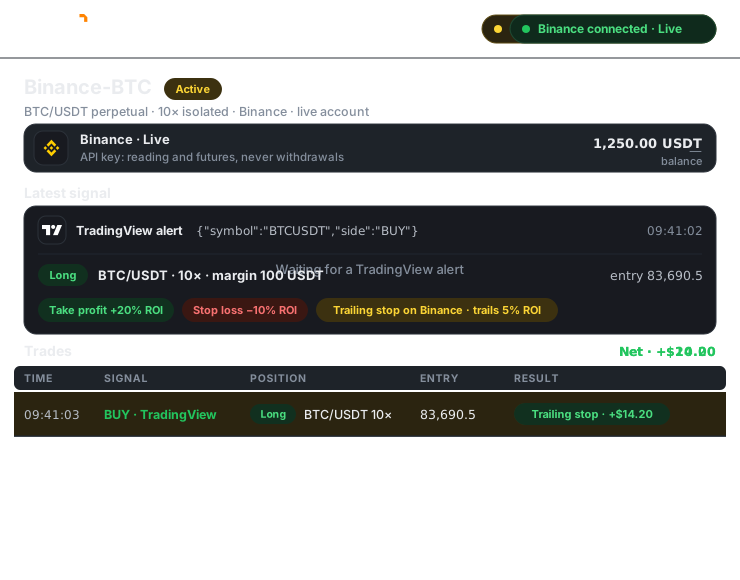
A live Binance account connected to Trader Frame with an API key, a TradingView buy alert opening a ten times long on BTC/USDT with take profit, stop loss and a Binance trailing stop, and the trade landing in the list
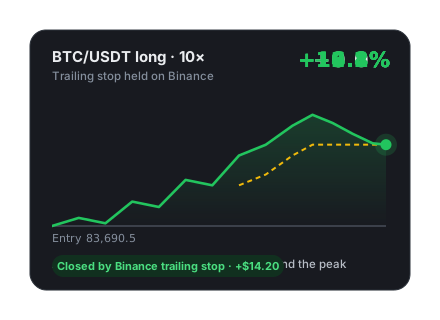
The BTC/USDT long rising while Binance's trailing stop follows it up, then closing the trade in profit

Before you start

What you need, and nothing to install

Binance connects over the internet, straight from Trader Frame. There is no app on your computer, and Trader Frame never sees your Binance password.
A Binance account

Your live account connects with an API key you create on Binance. For practice, use a Binance Futures testnet key.

USDT for margin

In your USD-M futures wallet. A testnet account trades test funds.

A signal source

TradingView alerts, Telegram, Discord, Copy Trader, or Pip, the AI Trade Agent.

Reading and Futures only

The key never needs withdrawals, on demo or live. Binance also wants our IP on the key.

What happens to every signal
Your signal
Says buy or sell, and the pair
Trader Frame
Size, leverage and exits from your bot
Binance
Binance
Order, stop, target and trail placed together

Your bot decides the size, the leverage and the exits. Binance holds the take profit, stop loss and trailing stop with the position.

Step by step

From a Binance account to a bot trading BTC/USDT

Practise on the testnet first if you like: steps 4 to 6 are the same for demo and live.

01
Step 1 of 6

Open Binance in the connect sheet

  • Open Brokers and press + Connect broker.
  • Pick the Crypto tab, then Binance, and press Continue.

The sheet asks which account to connect: Demo, with Binance Futures testnet keys, or Live.
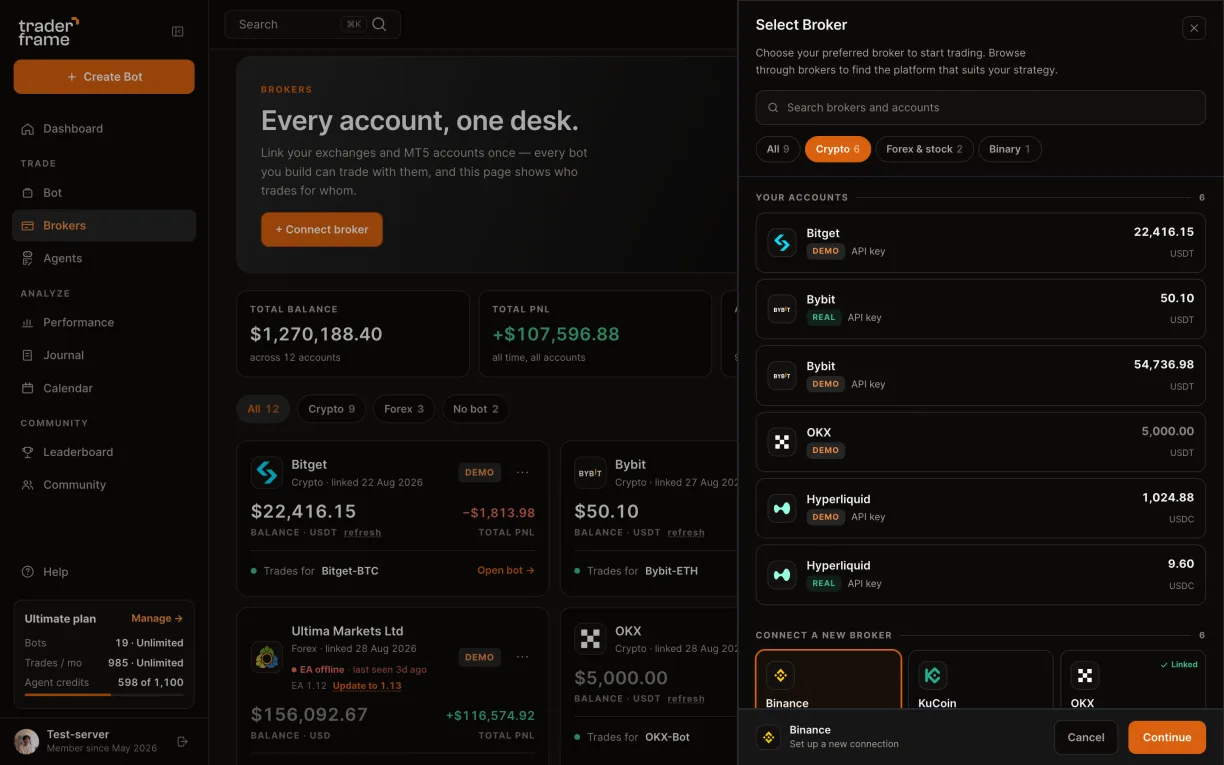
Opening the connect sheet from the Brokers page, picking the Crypto tab and Binance, and pressing Continue
02
Step 2 of 6

Practise on the Binance Futures testnet

  • On the Binance Futures testnet, create an API key with Reading and Futures enabled, never withdrawals.
  • Copy the IP shown in the sheet and add it to the key as a trusted IP.
  • Choose Demo, then paste the API key and secret.
  • Press Connect: the demo account appears with its balance.

Testnet keys are separate from the keys of your live account, and the testnet trades test funds only.
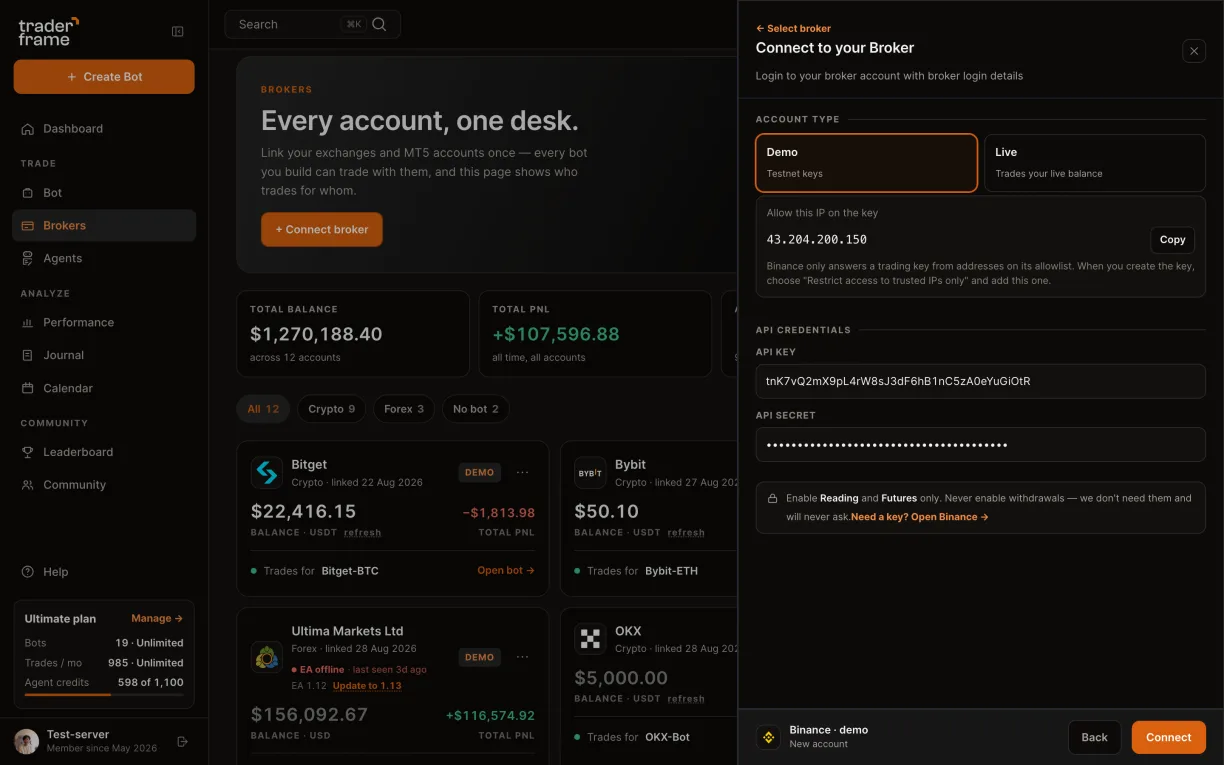
The Binance key notice, copying the IP to allow on the key, choosing Demo, pasting the API key and secret, pressing Connect, and the Binance demo account appearing on the Brokers page
03
Step 3 of 6

Connect your live account

  • Choose Live.
  • On Binance, create an API key with Reading and Futures only. Choose Restrict access to trusted IPs only and add the IP from the sheet.
  • Paste the API key and secret, then press Connect.

Binance only answers a trading key from the addresses on its allowlist. If Connect says Binance refused the key, add the IP shown in the sheet to the key and try again.
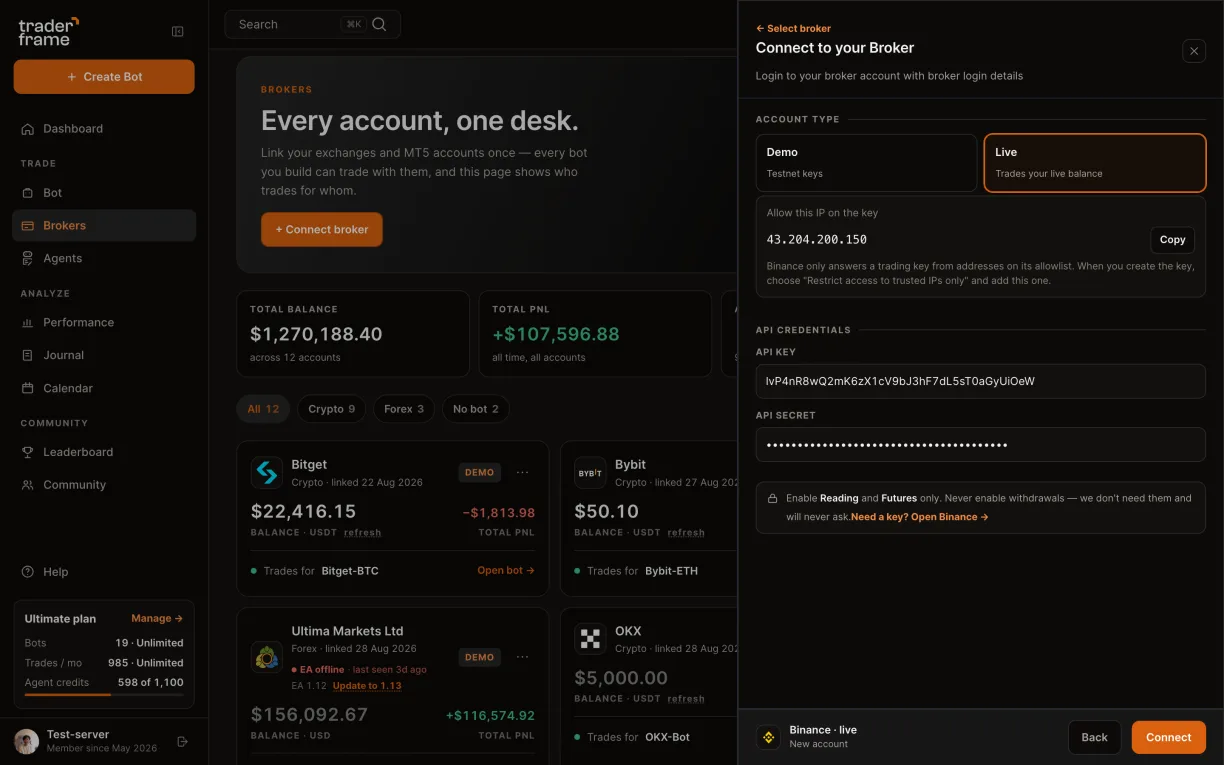
Choosing Live, the IP to allow on the key, pasting the API key and secret, and pressing Connect
04
Step 4 of 6

Build a crypto futures bot on Binance

  • Create a bot and pick your Binance account under Brokers.
  • In Position size, pick the trading pair, for example BTC/USDT.
  • Set the trade size: margin, order size or coins.
  • Choose the leverage and the margin mode, Cross or Isolated.

The panel shows what each trade commits: margin, notional at your leverage and the share of your balance.
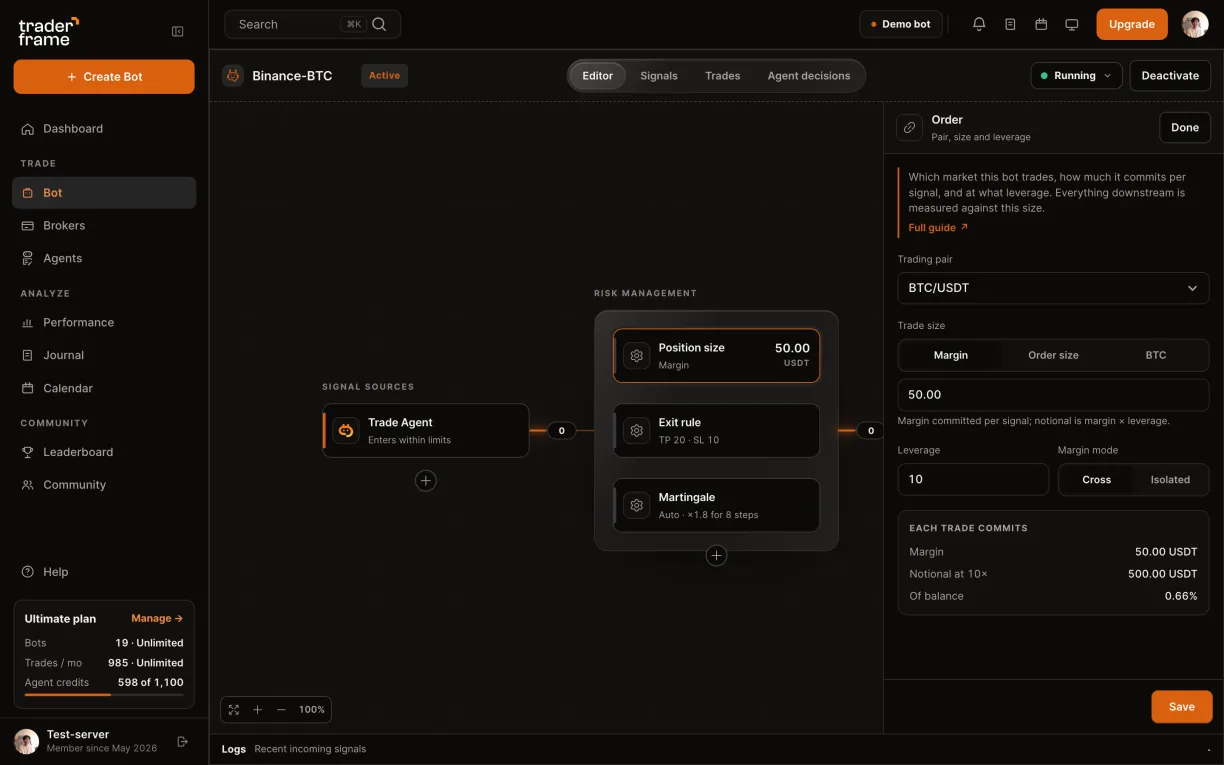
Picking the Binance account for a bot, then the BTC/USDT pair, trade size, 10× leverage and margin mode in the Position size panel
05
Step 5 of 6

Set the exits

  • In Exit rule, choose how positions close: Auto close at your target or stop, or follow the signal.
  • Set take profit and stop loss in ROI %.
  • Turn on the trailing stop: Continuous runs as Binance’s own trailing stop.
  • Check the position preview: prices and the result at take profit and stop loss.
  • Press Save.

ROI % is measured on the margin, so leverage sets how far the price moves for each percent.
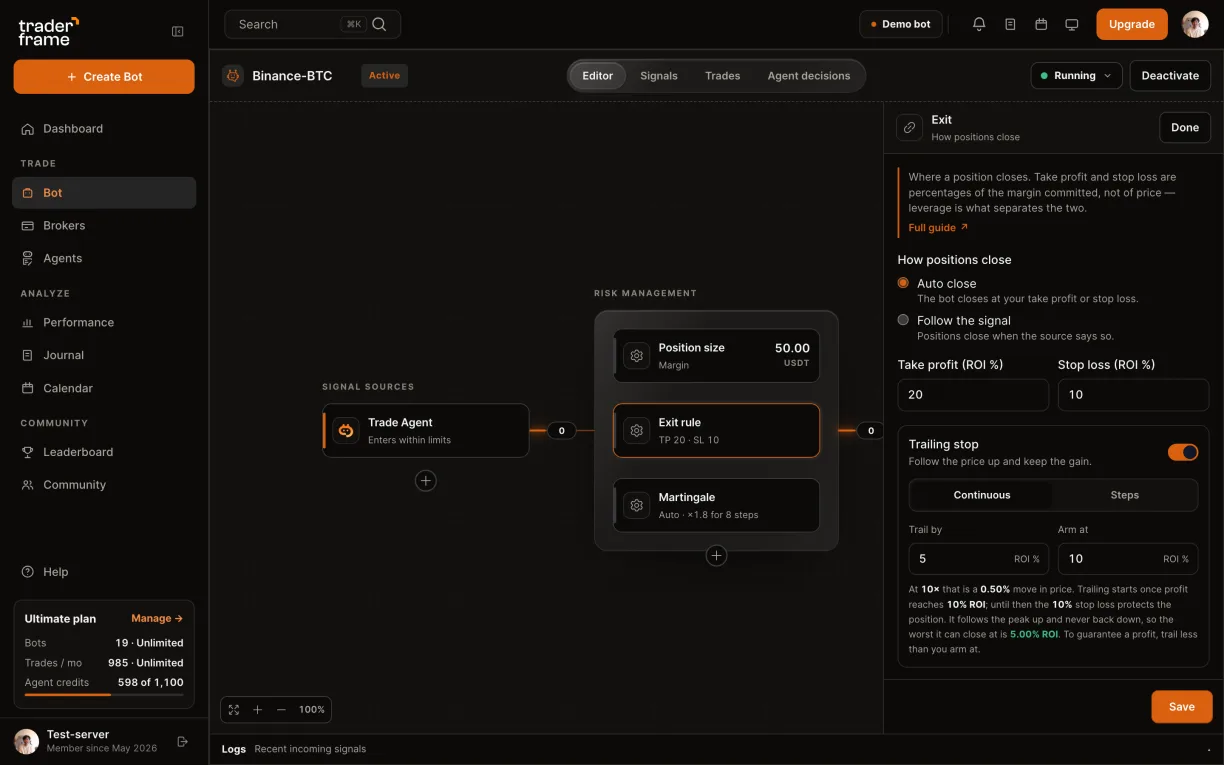
The Exit rule panel: auto close, take profit and stop loss in ROI %, a continuous trailing stop, the position preview, then Save
06
Step 6 of 6

Add a signal and switch it on

  • Under Signal sources, add Trading View for your alerts.
  • Or add Trade Agent and let Pip send the signals.
  • Press Activate.

Open the Trading View source for the webhook URL and the Buy and Sell alert messages, and paste them into your TradingView alert.
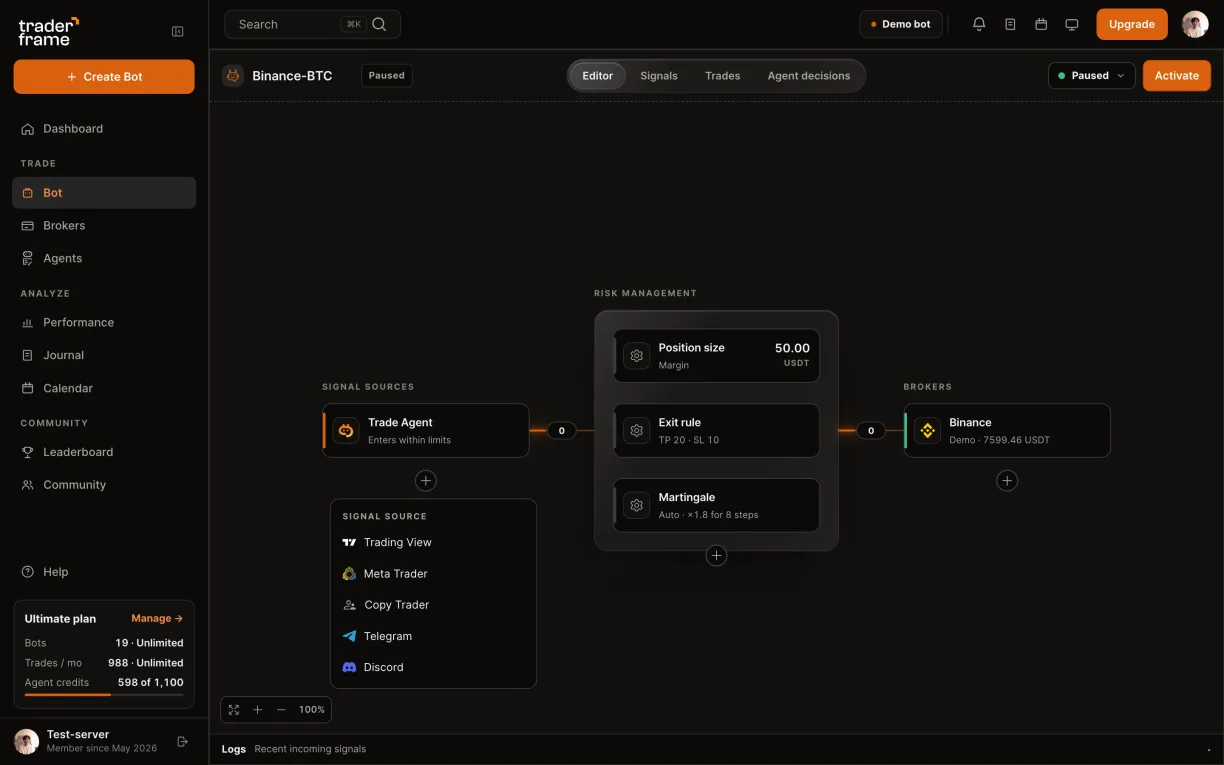
Opening the signal source menu with Trading View, the Trade Agent source that lets Pip trade, and pressing Activate

The alert message

The message only says buy or sell. The bot decides the size, the leverage and the exits.

TradingView
TradingView alert message · strategy
Copy it from the bot’s Trading View panel
{ "symbol": "{{ticker}}", "side": "{{strategy.order.action}}" }
TradingView
Indicator alerts · one per side
Buy opens a long · Sell opens a short
{ "symbol": "{{ticker}}", "side": "BUY" }
{ "symbol": "{{ticker}}", "side": "SELL" }

The alert names the pair the way your chart does, for example BTCUSDT. Size, leverage and exits always come from the bot.

AI trading agent for Binance

Meet Pip: an AI trading agent that trades Binance inside your limits

Pip is Trader Frame’s Trade Agent. Add it to a Binance bot instead of an alert: Pip reads the BTC/USDT perpetual market, decides when to go long or short, and explains every decision. Your bot still sets the size, the leverage and the exits.

Suggest
Pip proposes the trade and you place it or skip it. A proposal expires after 5 minutes.
Enter
Pip places the trade itself, inside your bot’s limits: size, leverage, trading hours and plan.
Manage
While its own position is open, Pip can move the stop closer (never wider) or close the trade.
Add Pip to a Binance bot
Pick Trade Agent under Signal sources

Can an AI agent trade Binance for me?

Yes. Add Pip, the Trade Agent, to a Binance bot as its signal source. Pip decides when to buy or sell; the bot places the order on Binance with your size, leverage and exits.

What does Pip read before a trade?

The pair’s candles on several timeframes, plus the market around them on Binance: spread, volume, funding on the perpetual and order-book depth.

Does Pip use my exits?

Yes. Take profit, stop loss and the trailing stop come from the bot’s Exit rule, and Binance holds them with the position.

How is Pip paid for?

Each look Pip takes uses agent credits from your plan. The Free plan has no agent.

Demo or live

Same bot, two ways in

Both connect with an API key you create: demo keys come from the Binance Futures testnet, live keys from your Binance account, and both need the IP shown in the sheet on their allowlist. Everything you build on top is the same, so a bot proven on demo moves to live by changing its broker.

Demo
Live
How it connects
API key and secret from the Binance Futures testnet
API key and secret from Binance
Funds
Test funds
Your USDT
IP allowlist
Add the IP shown in the sheet
Permissions
Reading and Futures, never withdrawals
Side by side
One demo account
One live account

Keeping it running

Day to day on Binance

Exits live on Binance

Take profit, stop loss and a continuous trailing stop are placed on Binance with the position, so they hold on their own. Closing by hand in Trader Frame cancels the ones left over.

Leverage and margin mode

Set per bot in Position size. Isolated limits a trade to its own margin; Cross shares your wallet, so the liquidation price depends on your balance.

Fees and funding

The position preview estimates entry and exit fees. Funding accrues while a position stays open and changes by market and hour, so it is not priced in advance.

Keys and the IP allowlist

The bot trades through the key you pasted. If you delete the key, or our IP leaves its allowlist, Binance refuses orders: fix the key or create a new one, and connect again.

Troubleshooting

What a message means, and what to do

Every refusal and skip is written to the bot’s Signals tab with its reason.

What you see
Why
What to do
Connect: “Binance refused the key”
The IP shown in the sheet is not on the key, Futures is not enabled, or the key was copied wrong.
Add the IP to the key, enable Futures, and paste the key and secret again.
Connect: “already have a connected account”
One demo and one live Binance account at a time.
Use the account you have, or disconnect it first.
Account card: “Key rejected”
Binance no longer accepts the key, for example after it was deleted or its IP list changed.
Create a new key with the IP on its allowlist, then connect again.
Demo or Live refuses a key that works
A live key was pasted into Demo, or a testnet key into Live.
Use a Binance Futures testnet key for Demo and a live key for Live.
Skipped: “Symbol mismatch”
The alert named a different pair than the bot trades.
Point the alert at the right bot, or change its pair.

FAQ

Binance questions

Does Trader Frame see my Binance password?

No. Demo and live both connect with an API key you create. Your password never reaches Trader Frame.

Why do I add an IP address to the key?

Binance only answers a trading key from the addresses on its allowlist. The connect sheet shows the address Trader Frame trades from, with a Copy button.

Can Trader Frame withdraw my funds?

No. The key only needs Reading and Futures. Never enable withdrawals: we don’t need them and will never ask.

Which markets can the bot trade?

Binance USDT-M perpetual futures, such as BTC/USDT, ETH/USDT and SOL/USDT, with the leverage and margin mode you set.

Is the trailing stop really on Binance?

Yes, in Continuous mode: Binance holds it with the position and moves it with the price. Steps mode moves your stop in stages from Trader Frame.

Can I keep demo and live side by side?

Yes. Connect one demo and one live Binance account, and point each bot at the one you want.

Start on the testnet

Practise on the testnet. Go live with the same bot.

When the bot has earned it, connect your live Binance account with a new key and point the same bot at it. Nothing else changes.